Transaminases are powerful biocatalysts. But unlocking their full industrial potential requires more than a highly active enzyme: it requires a catalyst that can operate efficiently for extended periods of time. By combining enzyme engineering with immobilization and continuous flow, Johnson Matthey and Cascade Bio demonstrated a transaminase that maintained activity for more than 50 days, illustrating how longer catalyst lifetime can translate the promise of biocatalysis into more compelling manufacturing economics.
The Industrial Impact of Transaminases
Few enzyme classes have transformed industrial biocatalysis as much as transaminases. These enzymes produce chiral amines, one of the most important classes of molecules in modern chemistry. Chiral amines are found throughout pharmaceuticals, crop protection products, flavors and fragrances, and specialty chemicals, making them essential building blocks across a wide range of industries. In fact, roughly 40% of commercial pharmaceuticals contain at least one chiral amine.
For decades, manufacturing these molecules efficiently has been a challenge. Traditional chemical routes often require multiple synthetic steps, leading to overall low yields. In many cases, manufacturers intentionally produce equal amounts of both mirror-image molecules, even though only one possesses the desired biological or chemical activity. The undesired product must then be separated, recycled, or discarded, which increases cost, waste, and process complexity. While these approaches have enabled countless commercial products, they often come with tradeoffs inefficiency, sustainability, and manufacturing economics.
Transaminases offer a fundamentally different approach. Rather than producing both mirror-image products, they selectively produce the desired chiral amine under mild reaction conditions with exceptional stereoselectivity. What once required multiple chemical transformations can often be accomplished in a single enzymatic step. The result is a more streamlined process with fewer purification steps, lower waste generation, and improved sustainability.
It is one of the reasons transaminases have become one of the defining success stories in industrial biocatalysis.
Transforming a Great Enzyme into an Industrial Catalyst
Industrial manufacturing is not optimized around an enzyme's initial activity. It is optimized around how much product that enzyme can produce over its lifetime, reflected by the total turnover number (TTN) of the biocatalyst. The longer an enzyme remains active and the lower the catalyst loading (i.e., the amount of biocatalyst required to achieve a given reaction), the more economically attractive the process becomes.
An enzyme that delivers excellent performance for a few hours may never become commercially viable. An enzyme that remains active for weeks or months can fundamentally change the economics of a manufacturing process. Every additional day of catalyst lifetime means more product from the same amount of enzyme, fewer reactor shutdowns, lower catalyst consumption, and lower operating costs.
Catalyst loading is equally important. The less biocatalyst required to achieve a given level of productivity, the lower the cost of the process. A highly active, stable enzyme can often be used at lower loadings because each molecule performs more catalytic turnovers before becoming inactive. Together, long catalyst lifetime and low catalyst loading multiply the value of every gram of enzyme, reducing enzyme costs while increasing reactor productivity and making biocatalytic processes far more competitive with traditional chemical manufacturing.
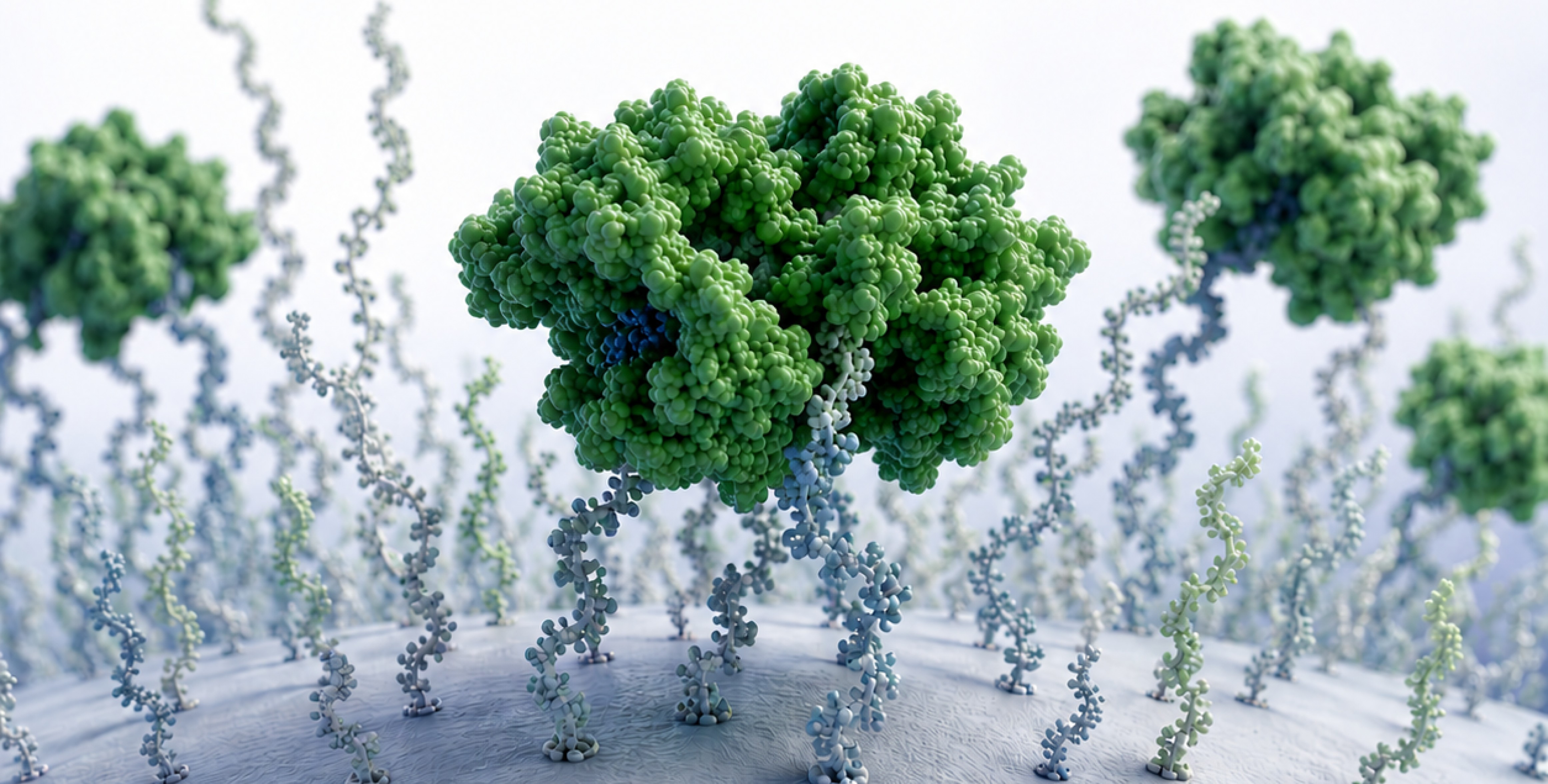
One of the most effective strategies for achieving these performance and economic targets is enzyme immobilization. By attaching enzymes to engineered solid supports, immobilization allows catalysts to be recovered and reused while often improving their stability under manufacturing conditions. Instead of replacing soluble enzymes after every reaction, immobilized enzymes can continue producing product across many batches or remain active for extended continuous operation.
The benefits become even more significant in continuous flow manufacturing. Immobilized enzymes can be packed into a reactor while substrate continuously flows through the catalyst bed. The enzyme remains in place while product exits the reactor, allowing production to continue for days or even weeks. Longer operating campaigns improve reactor utilization, reduce downtime, simplify catalyst handling, and increase the amount of product generated from every gram of enzyme.
Commercial success requires much more than discovering a high-performing enzyme. It requires bringing together enzyme engineering, immobilization, reaction engineering, process development, manufacturing, and scale-up into a single optimized process. The best commercial processes are built by improving the entire system.
The Collaboration between Johnson Matthey and Cascade Bio
Johnson Matthey has built one of the industry's most comprehensive biocatalysis platforms, with capabilities spanning enzyme discovery, computational enzyme engineering, directed evolution, process development, and commercial implementation. Their team develops enzymes with industrial performance in mind and has extensive experience translating promising biocatalysts into scalable manufacturing processes.
Cascade Bio brings complementary expertise in enzyme immobilization and catalyst stabilization. Together, our teams set out to answer a straightforward but important question. What happens when a high-performing industrial transaminase is paired with an immobilization platform specifically designed to maximize its long-term performance?
The collaboration began with one of Johnson Matthey's engineered transaminases. Working closely together, we rapidly developed an immobilization process tailored to that enzyme, optimizing loading onto Cascade Bio's support materials while maintaining catalytic performance. From there, the work became highly iterative. Experimental data from immobilization informed the next round of optimization. Frequent communication between both teams allowed ideas to move quickly from experiment to experiment, accelerating development and ensuring that enzyme engineering, immobilization, and process development evolved together rather than independently.
The Experimental Results and Next Steps
Together, Johnson Matthey and Cascade Bio demonstrated an immobilized transaminase capable of maintaining catalytic activity for more than 50 days in continuous flow. While every process presents unique technical and economic requirements, results like these illustrate how enzyme engineering and immobilization can work together to create catalysts that behave more like traditional industrial catalysts, delivering consistent performance overextended operating campaigns.
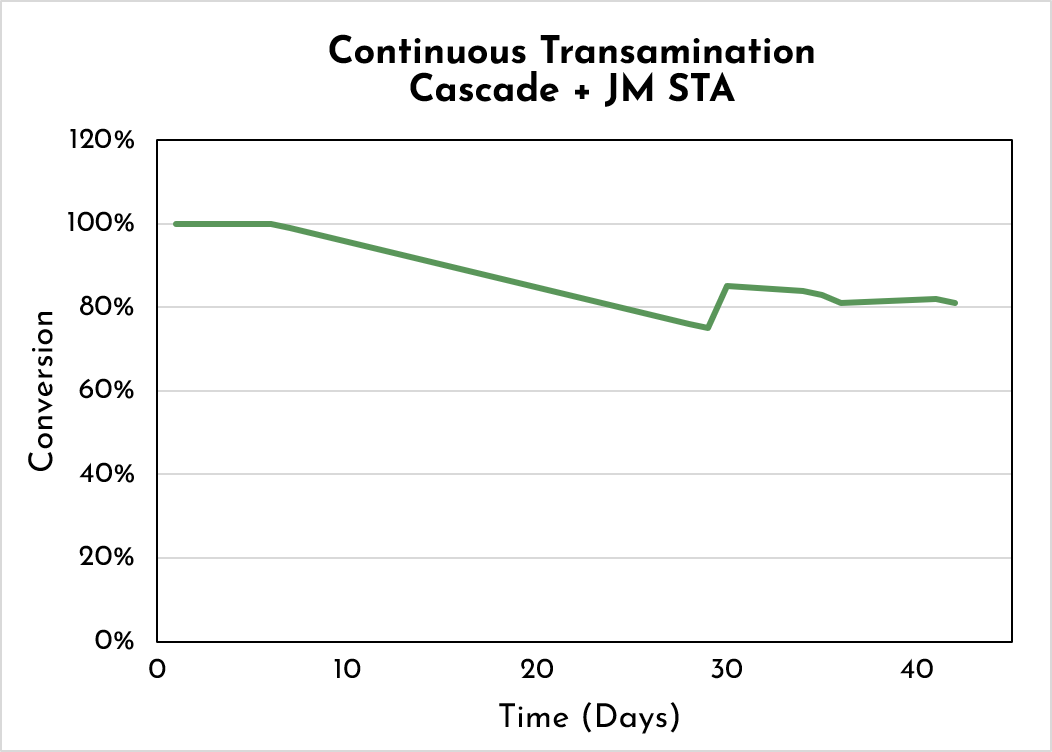
This result reflects what Cascade Bio's immobilization technology is designed to deliver: extending catalyst lifetime so that enzymes can generate more product, run longer, and be replaced less often, directly improving the economics of a biocatalytic process.
The past two decades of biocatalysis have been defined by discovering and engineering better enzymes. The next decade will be defined by building better biocatalytic processes around them.
By combining complementary expertise across the biocatalysis ecosystem, we believe we can accelerate the adoption of enzymes across manufacturing and unlock new opportunities for the bioeconomy.
The future of industrial biocatalysis will not be built through better enzymes alone. It will be built through better processes and collaboration.